The Umbra thesis
The need for privacy no longer stops at onchain finance; we expect it to reach every system that holds or moves money. Cryptographic primitives and privacy have expanded from a crypto niche into an expectation and a requirement. Umbra is one of the few teams building that layer where the flows already are.
Public blockchains made settlement verifiable by making everything visible. That trade-off worked while crypto was relatively small and its primary users were early adopters. It works far less well now that wallets hold real wealth, companies run payroll onchain and institutions are arriving with mandates that forbid publishing their positions.
Over the last year, the clearest expression of the demand for privacy has been the rise of Zcash. The protocol has been live for a decade, yet it went largely unappreciated until the last 12 months, when ZEC returned to the top 10 by market cap and the share of its supply held in shielded pools reached 29.2%. The market is telling us that there is clear demand for privacy and for shielded assets.
Zcash is a phenomenal private store of value, but we do not think it is the most practical foundation for productive assets and private finance. We think privacy protocols should be optimized for trading and payments, which is what crypto is ultimately designed best for. After evaluating many privacy protocols and products, we believe zero knowledge (ZK) is the optimal design choice, ahead of fully homomorphic encryption (FHE) and multi-party computation (MPC). The latter two are strong technologies, but we do not think either truly enables what crypto is designed for at the speed that trading and payments demand. That conclusion led us to Umbra.
Umbra's v2 is now live and runs on Nimbus, a ZK privacy protocol the team built from the ground up after moving off Arcium. Private transfers settle in under five seconds and private swaps in about 15 to 20. And because Nimbus shields the tokens people already hold instead of minting confidential copies, protocols such as Kamino can plug in directly.
Why privacy matters more than ever
Crypto's founding promise was self-custody, yet its default design is radical transparency. For most of the industry's life the two coexisted, because the amounts were small and the users were hard to identify. Neither is true anymore, and we think the consequences now reach well beyond crypto.
An onchain balance is not only an attestation, but also an attack vector for bad actors. CertiK documented 72 verified physical coercion incidents against crypto holders worldwide in 2025, up 75% from 41 in 2024. Kidnapping was the leading vector, physical assaults rose 250% and confirmed losses exceeded $40.9M. France recorded 19 incidents, more than any other country. Chainalysis puts the value stolen in violent attacks at a record $58M in 2025, with another $30M by mid-2026, and finds home invasions rising to 37% of incidents this year. Attackers pick targets through open-source research, and a wallet linked to a name is the cheapest research there is.
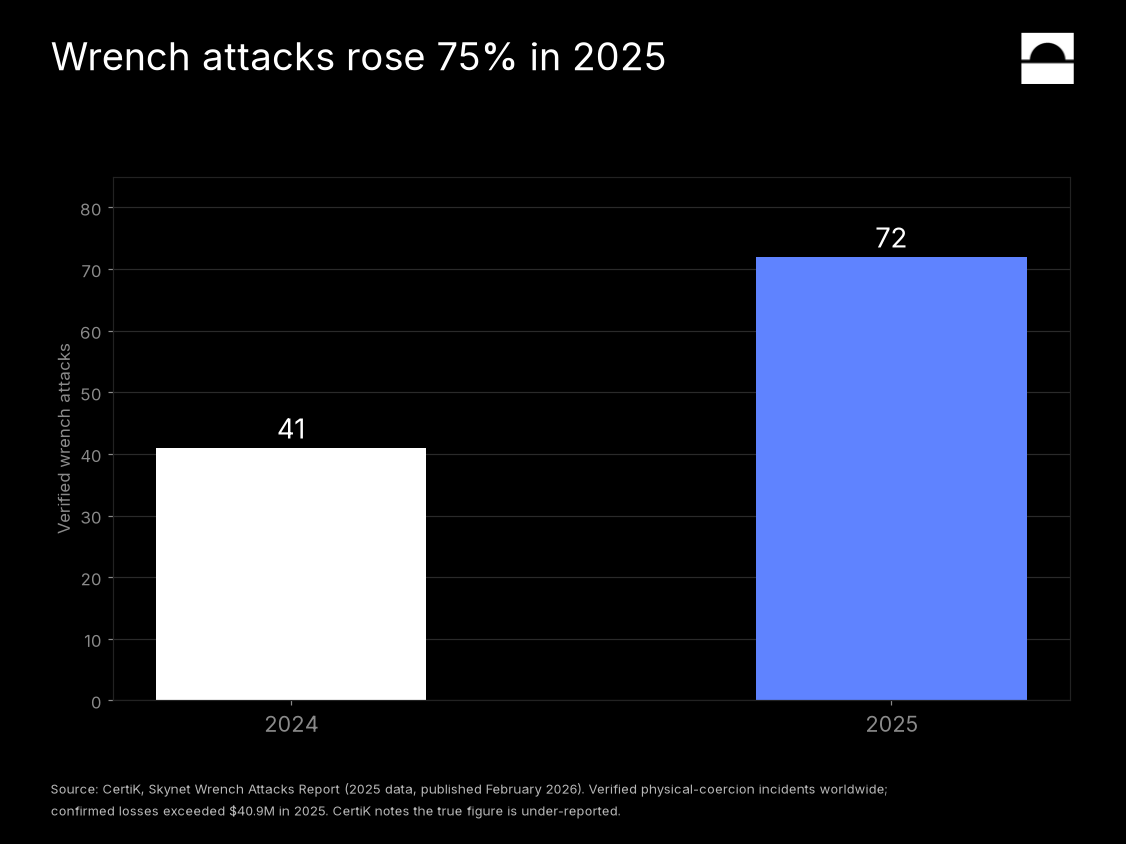
Source: CertiK, Skynet Wrench Attacks Report (2025 data). CertiK notes the figures understate the true number because of under-reporting and silent settlements. Chainalysis separately estimates $58M stolen in violent attacks in 2025.
Identity leaks at the edges, where exchanges tie wallets to real names and addresses. In May 2025, Coinbase disclosed that overseas support contractors had taken customer data. It later said the breach affected 69,461 customers, and its 8-K filing estimated $180M to $400M of remediation and reimbursement costs. Once one deposit address is linked to a person, wallet clustering links the rest, as Umbra's own Nimbus documentation puts it.
On a transparent chain, business strategy becomes public by default. A company that pays salaries from one wallet publishes what each employee earns, a treasury tells the market what it is about to do, and a merchant's receiving address shows its revenue and lists its customers. Traders are tracked and copied in real time, and we can see this with the proliferation of social trading apps such as Fomo and Pump Fun.
People already expect this protection from the rest of their financial lives. In Pew Research Center's 2023 survey, 81% of US adults said they were concerned about how companies use the data collected about them, and 71% about how the government uses it. We see no reason they will accept less from the financial rails that come next.
Institutions cannot operate in public, and that is holding capital back. Traditional markets let large investors execute without broadcasting their positions or activities, whereas onchain, they mostly cannot yet. As more capital and assets move onchain, institutions are going to expect confidentiality. The demand is now measurable – Zama's first confidential Morpho vault grew from zero to more than $40M in seven weeks, and the product has since expanded to 16 vaults across five curators, including Wintermute's Armitage and Bitwise.
Policy has turned in privacy's favor, though unevenly. For most of the last cycle, privacy tools were treated as presumptively illicit. The direction of travel is privacy with accountability: tools that hide activity from the public while keeping screening and selective disclosure available to the people who are entitled to them. We think that is the design that wins, and it is the design space Umbra sits in.
What privacy in crypto has historically looked like
We think of privacy in crypto as three eras: first private money, then private applications, and now private infrastructure that plugs into the venues people already use. Each era taught the next one something.
| Date | Milestone | What it taught the market |
|---|---|---|
| April 2014 | Monero launches Monero | Privacy by default can sustain a large, durable community |
| 28 October 2016 | Zcash launches with zk-SNARK shielded transactions Zcash timeline | Zero-knowledge proofs work in production; optional privacy keeps exchange access |
| 15 September 2020 | Secret Network turns on encrypted smart contracts Secret Network | Private computation is possible, but needs its own chain and liquidity |
| July 2021 | Railgun launches on Ethereum Railgun | Shielded pools can sit beside existing onchain venues |
| 8 August 2022 | OFAC sanctions a widely used Ethereum mixer Venable | Regulatory risk becomes the dominant variable; mixers with no screening or record become the cautionary tale |
| March 2023 | Aztec Connect shuts down Aztec | Running privacy infrastructure is expensive; operator risk is priced in |
| February 2024 | Binance delists Monero; Elusiv sunsets on Solana Binance; SIP | Distribution can be switched off; standalone apps struggle |
| July and December 2024 | Penumbra (5 July) and Namada (3 December) launch mainnets Penumbra; Namada | Privacy-first chains arrive, but liquidity stays elsewhere |
| 21 March 2025 | Treasury lifts those sanctions Venable | The policy regime turns |
| 2025 to 2026 | ZEC re-rates into the top 10; Zama ships confidential Morpho vaults Fortune; Zama | Privacy becomes an institutional trade |
Sources as linked. Dates are as reported by each project or source.
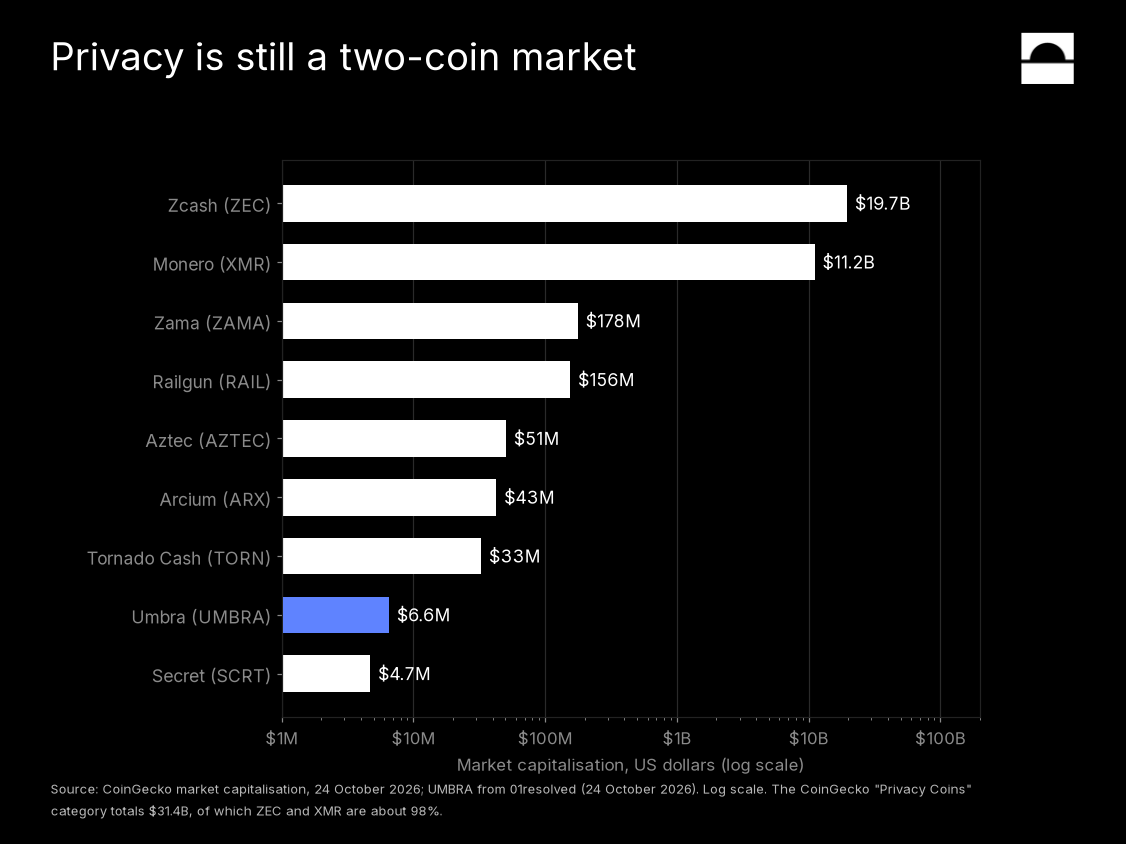
Source: CoinGecko, 24 October 2026; UMBRA from 01resolved. Log scale.
Onchain privacy usage, by contrast, is still small.
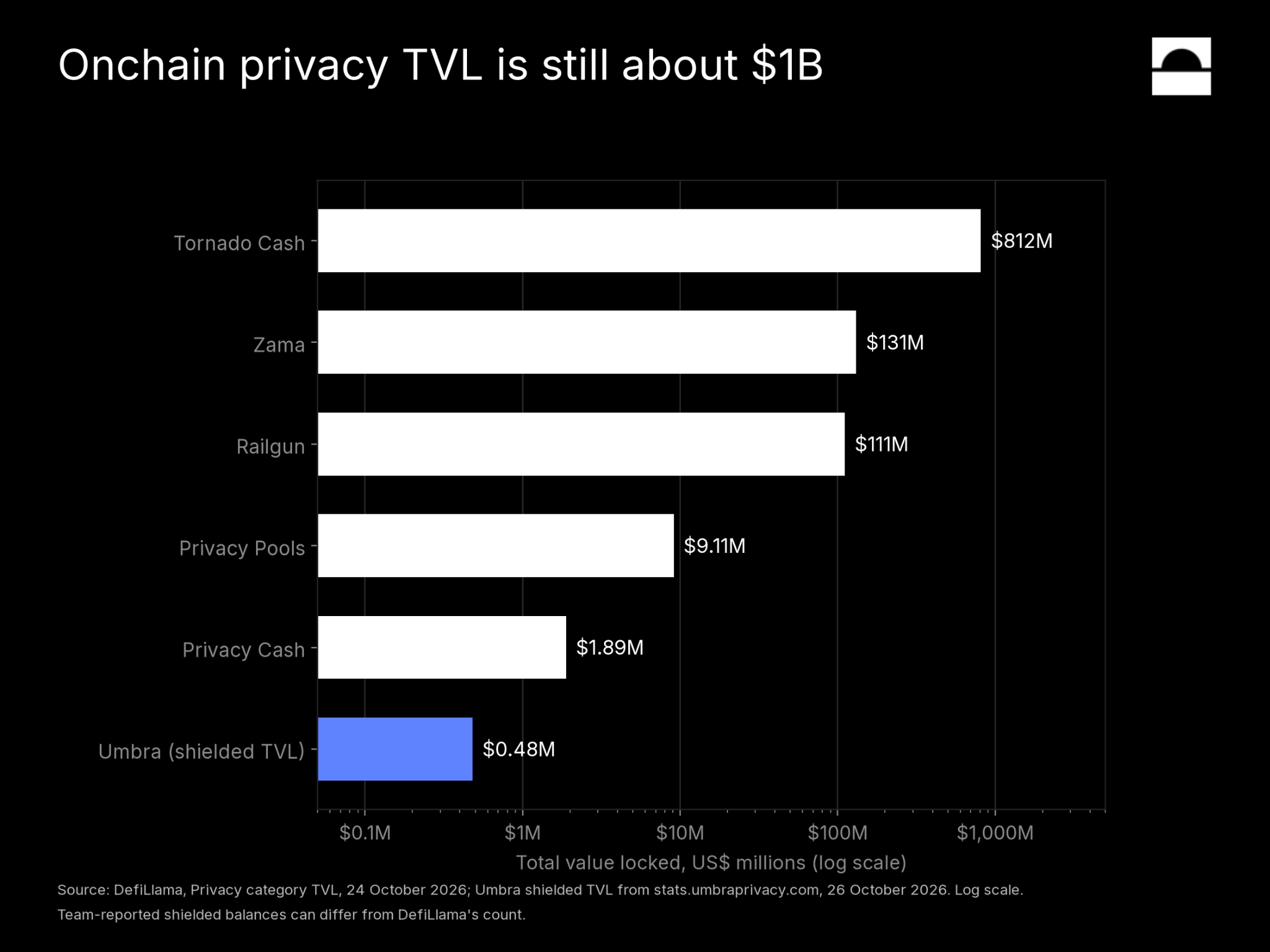
Source: DefiLlama, Privacy category, 24 October 2026. Log scale. Team-reported shielded balances can differ from DefiLlama's count.
We draw three lessons from this history. Privacy assets that survived had real users and deep liquidity. Standalone privacy apps on general-purpose chains mostly struggled: Elusiv sunset and its team became Arcium, while Helius bought Light Protocol to build a privacy layer of its own. And compliance design decided distribution, because exchanges delisted what they could not screen and institutions waited for something they could explain to a risk committee.
Why Zcash came back
Zcash originally began as research. In 2014 a group of cryptographers published Zerocash, showing how zero-knowledge proofs could let a blockchain confirm a payment while hiding its sender, recipient and amount. Zcash launched on that design in October 2016, a decade ago as of this week, becoming the first widespread production use of zk-SNARKs.
The decade since has been a steady effort to make that privacy usable. The Sapling upgrade in 2018 cut the cost of a shielded transaction from about 40 seconds and 1.5GB of memory to a few seconds and 40MB, which brought shielded payments to phones. NU5, in May 2022, moved the newest shielded pool, Orchard, onto the Halo 2 proving system and removed the need for a trusted setup. Viewing keys let a holder give an auditor, an exchange or a regulator read-only access to their transactions without giving up control of the funds.
What Zcash enables is simple to state: money that can be held and sent without broadcasting who owns it, with disclosure left in the owner's hands. That is why we call it a phenomenal private store of value. For most of its life the market did not price that. Over the last 12 months it did, with ZEC setting a record high of about $1,600 along the way.
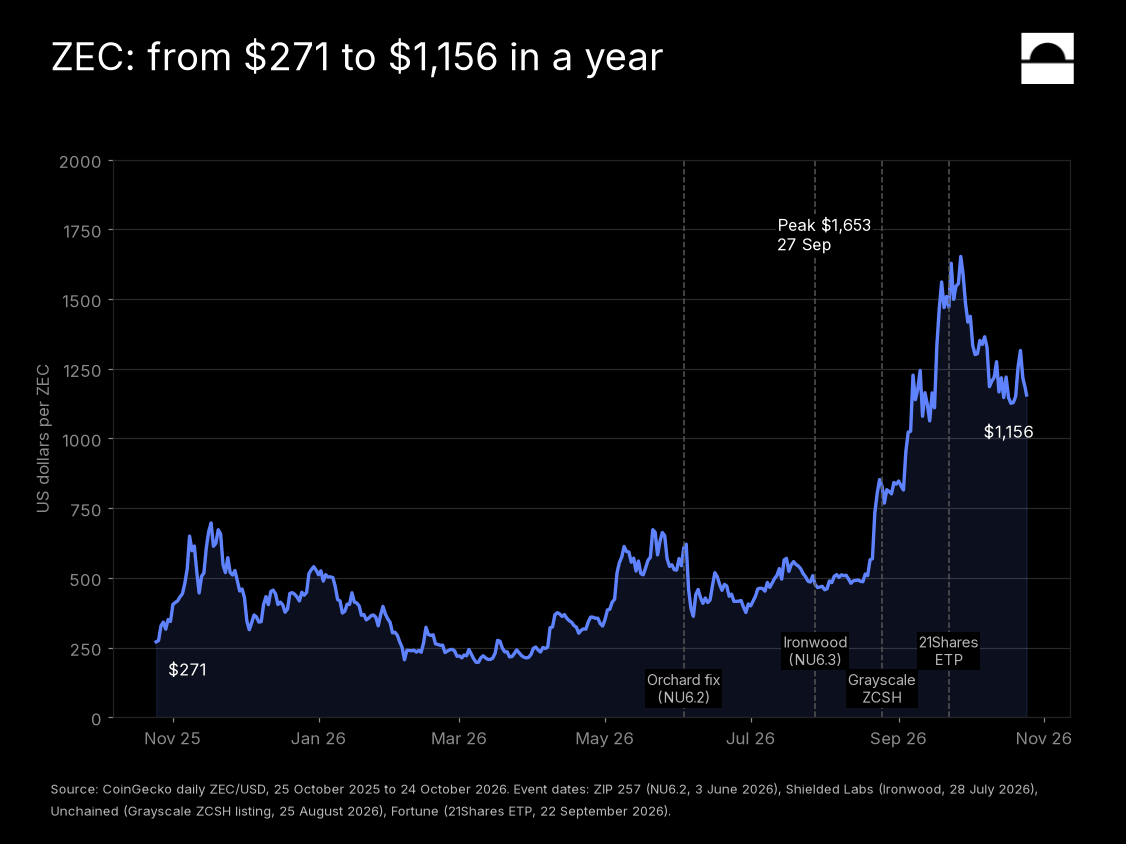
Source: CoinGecko, 25 October 2025 to 24 October 2026. Events: ZIP 257, Shielded Labs, Unchained, Fortune.
We think the more important signal is usage. As of October 2026, 29.2% of issued ZEC, about 4.97M coins worth $5.74B, sits in shielded pools. Blockworks' Q3 2026 tokenholder report shows shielded ZEC rising 11.8% in the quarter to 4.94M, with the shielded share climbing from 26.3% to 29.1%, and more than half of non-coinbase transactions using a shielded pool. Holders pay a usability cost to shield, so a record share doing so while the price ran tells us the buyers wanted the product, not just the ticker.
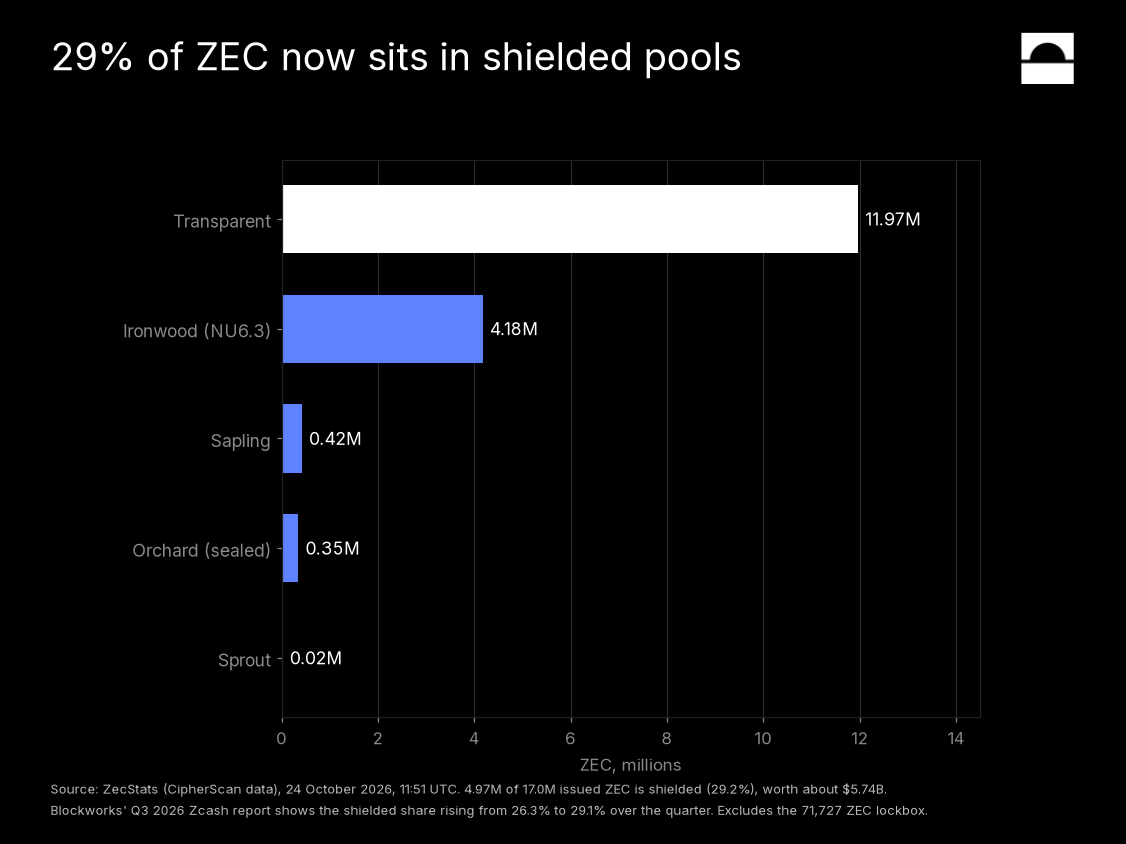
Source: ZecStats (CipherScan data), 24 October 2026, 11:51 UTC; Blockworks, Q3 2026.
We see five drivers behind the move:
- Investors finally got a regulated way in. Grayscale listed its spot Zcash ETF, ZCSH, on NYSE Arca in August 2026. It passed $500M of AUM by September 2026 and drew about $263M of net inflows by quarter end. 21Shares followed with Europe's first physically backed ZEC product on Euronext.
- Flows from institutions followed that access. Multicoin disclosed a significant position, and Cypherpunk Technologies, a listed Zcash treasury company backed by the Winklevoss twins, has accumulated 2% of the ZEC supply and invested heavily in mining. DCG contributed 85,705 ZEC to ZCSH in exchange for about $100M of shares. Another notable and vocal investors include Balaji, Naval, etc.
- The technology kept shipping. Zakura, a new full node, cut a full sync from about 21 hours to about four, and NU7, with 25-second blocks, is scheduled for mainnet on 5 November.
- The narrative caught up with the product. AI-enabled surveillance, quantum risk and the cypherpunk ethos all featured in coverage of the run.
- Even a hiccup was resolved in public. In May of this year, an AI-assisted audit found a soundness bug in Orchard's circuit that could have allowed counterfeit ZEC. Orchard was disabled on June 1st and fixed by the NU6.2 hard fork on June 3rd. Ironwood then sealed the old pool on July 28th so that any counterfeit coins could not leave it, and shielded supply recovered within the quarter.
The lesson for Umbra is specific. Privacy re-rated when three things lined up: institutions got a regulated way in, usage showed up in public data, and the technology kept shipping. We think the same three tests are the right ones to apply to Umbra. The Orchard episode is also a reminder that zero-knowledge circuits carry real tail risk, and that the market rewards teams that handle it transparently.
There is a structural point as well. Zcash is private money on its own chain. Solana, which handled about $1.04T of the roughly $3.37T of DEX volume across all chains over the last 12 months, has no native shielded pool for the assets that trade on it. We think there is a massive market opportunity here.
Umbra v1: proving demand
Umbra began as privacy for swaps and transfers, built on Arcium. Its token launch on MetaDAO became one of the clearest demand signals the privacy sector has produced, and the team spent the following year turning that demand into a product.
- The MetaDAO ICO drew $154.9M of commitments. Umbra launched its token via MetaDAO in October 2025.
- Umbra then shipped mainnet on Arcium. It was the first application on Arcium's Mainnet Alpha, starting with a phased private mainnet in February 2026.
- The wallet opened to the public in March 2026. On March 27, Umbra launched shielded transfers, encrypted swaps, viewing keys, risk screening and geo-blocking, plus an SDK.
- Integrations broadened the product. Confidential vesting with Streamflow followed in May 2026, alongside real-time risk and compliance screening from Range.
v1 proved that people wanted private balances on Solana, and it showed the team exactly what had to change: transfers could stay in transit for a few minutes, and a deposit took about 21 signatures. Rather than iterate around those limits, the team chose to rebuild the stack, and in October 2026 Umbra began moving users to v2. We think the willingness to replace a working product with a better one says a lot about how this team prioritizes.
Umbra v2: building the stack from the ground up
Umbra v2 went live on October 13, 2026. Under it sits Nimbus, the team's own privacy protocol – a set of Solana programs, zero-knowledge circuits and supporting services that give users a private balance.
The first decision behind v2 was to own the privacy layer rather than rent it. Co-founder Kru said Arcium's focus was too broad for a team that wanted to work only on financial privacy, so Umbra built its own network. We think that was the right call for three reasons. Owning the stack lets Umbra control the things users feel, namely speed, fees and the number of signatures. It lets Umbra design compliance into the protocol rather than bolt it on. And it turns Umbra from an app on someone else's infrastructure into infrastructure that others build on via builder codes, with Umbra earning fees and revenue through Nimbus.
Owning the stack also meant choosing the cryptography, and Umbra chose zero knowledge, the same conclusion we reached. Nimbus uses notes and proofs and does not compute on encrypted balances. Each user's device builds its own Groth16 proof in the browser, so keys and note contents never go to a proving service. Every deposit, transfer and withdrawal uses the same transaction shape, so the shape itself reveals nothing. Notes are encrypted with ML-KEM-768 and AES-256-GCM, which protects them against later decryption by a quantum computer, though the proofs and signatures themselves are not post-quantum. An escape hatch lets a user exit with only a proof if an attester is offline. In practice, the move from v1 to v2 shows up as speed and simplicity: transfers in under five seconds and deposits in one signature instead of about 21.
| Umbra v1 | Umbra v2 | |
|---|---|---|
| Live | Phased private mainnet from February 2026; public wallet March 2026 | October 2026 |
| Privacy engine | Arcium encrypted execution network | Nimbus: Umbra's own shielded pool, ZK circuits and attesters |
| Transfer time | Could stay in transit for a few minutes | Under 5 seconds |
| Signatures to deposit | About 21 | One |
| Proofs and computation | ZK anonymity stack plus Arcium encrypted computation | Groth16 proofs built on the user's device; no encrypted computation |
| Chains | Solana | Solana, with Robinhood Chain in development |
| Business model | App | App plus infrastructure (Nimbus SDK and API) |
Sources: MCG interview with Umbra (13 October 2026, team-reported and not independently verified); The Block; Arcium; Nimbus docs; Umbra on X.
That speed matters because of what Umbra is building for: trading and payments, the two flows where crypto already operates at real scale. Solana DEXs alone did about $1.04T of volume over the last 12 months, and dollar stablecoins in circulation total about $300B, $15.5B of it on Solana. Those are also the two places where transparency hurts most. A visible trade gets front-run or copied, and a visible payment exposes salaries, suppliers and margins. Umbra's products map directly onto both.
| Product | Chains | Speed | Fee | Status |
|---|---|---|---|---|
| Private Transfers | Solana, Robinhood Chain | Under 5 seconds | 0.35% | Live |
| Private Swaps, Tier 1 | Solana, Robinhood Chain | About 15 to 20 seconds | 0.6% net | Live; Tier 2 in design |
| Private Withdrawals | Solana, Robinhood Chain | n/a | 0.50% | Live |
| Private Yield | Solana, Robinhood Chain | n/a | n/a | In design; kmUSDC and kmSOL already held in Umbra pools, per Umbra's Kamino page |
| Private USDv (uUSDv) | Solana | n/a | n/a | Live; holders receive 75% of USDv rewards, about 2.6% a year at a 3.5% USDv rate |
| Umbra Pro | Solana, Robinhood Chain | n/a | n/a | Live |
Source: Umbra product documentation and Novora call with Umbra, 23 October 2026, unless linked; Nimbus/Umbra documentation (October 2026). Transfer and withdrawal fees follow the current mainnet fee policy: 0 bps on deposits, 35 bps on private transfers and 50 bps on withdrawals.
The bigger idea is Nimbus as a network that others build on. Companies integrate private transfers, swaps and pools once, and every chain they serve settles to Nimbus, starting with Solana and Robinhood Chain. Below that layer sit the suppliers: solvers that execute private swaps end to end, yield protocols and token teams. One integration, in Umbra's words, "covers wallets, fintech apps and onchain services".
Screening and a record in every transaction
We think the most underappreciated part of v2 is that its controls are conditions of settlement rather than policies layered on top. No value transaction settles on Nimbus until six attesters have each signed it, and the screener is one of the six. Their signatures combine into a single signature that the pool checks against all six keys together, so it is six of six, not a threshold. Before it signs, the screener runs CipherOwl and OFAC SDN checks on the submitter of the transaction, on every depositor and source owner, and on every withdrawal recipient. Only a clear verdict is signed, and an incomplete answer counts as a refusal.
The record is enforced the same way. Every transaction's proof forces an encrypted sender record, covering identity, tokens and amounts, into the transaction itself, so it cannot be left out or falsified. The viewing keys that could open those records are sharded across three guardian enclaves, one share each, and a single share reveals nothing. And disclosure can be narrow: a sender can prove one chosen field, such as an amount, to a zone authority without revealing anything else about the transaction.
Today, the guardian nodes that hold viewing-key shares are operated by Umbra alone, and no path exists to release a share. Umbra's next step is to bring independent outside partners into guardian governance, so that no key action can happen without both the Umbra team and an outside partner agreeing, with every action published and open to veto. Over time, the plan extends to more partners, more nodes and more infrastructure providers, so that no single company, Umbra included, can see into a user's history on its own. Privacy from the operator, not just from the public, is the standard serious financial users will expect.
This is what we think makes privacy usable as a baseline for regulated finance. A treasury, a payments company or a fund can hold balances that the public cannot read while still being able to show that every counterparty was screened and that an encrypted record exists for every transaction. That is a fundamentally different proposition from mixers with no screening or record, and from systems that leave disclosure entirely to the user. In our view, screening and an encrypted record built into every transaction are what open the doors that stayed closed to earlier privacy tools.
Early traction is encouraging. v2 started on Solana, where the team reported more than $500K shielded in its first week, and Robinhood Chain now live. Its launch partners include Turnkey, whose Verifiable Cloud hosts Umbra's guardian nodes, and Jupiter.
Why v2 makes sense for onchain finance
The design choice that matters most for onchain finance is simple to state: Nimbus shields the tokens people already hold. The pool accepts SOL and governance-allowlisted SPL and Token-2022 tokens, and balances inside it are notes denominated in the same mint. Nothing is wrapped into a new asset.
The way the pool is built sharpens that fit. Notes can hold any 64-bit amount of SOL or a supported SPL token, so there are no fixed denominations that give amounts away, and every token sits in one shared commitment tree. A USDC spend and a SOL spend therefore draw on the same anonymity set, and each new asset adds to one crowd rather than starting its own. Every transaction also has the same shape, three notes in and three out, with unused slots filled by dummy notes, so an observer cannot tell a deposit from a transfer or a swap leg by its structure.
As described above, proofs are built on the user's device and only the note encryption is post-quantum.
That combination is what separates Nimbus from the two other models we see most often. Single-asset privacy chains offer strong cryptography but for one coin; Zcash's shielded pools hold ZEC only, so a trader or treasury has to leave the assets it actually uses. Operator-based designs, which keep activity private inside trusted execution environments or behind intermediaries, ask users to trust hardware and operators for confidentiality and apply screening as operator policy. Nimbus keeps privacy enforced by proofs on the user's own device, for the tokens onchain finance already runs on, with its enclaves limited to co-signing and holding key shares.
Kamino is the clearest example of what that makes possible. Kamino Lend holds about $1.26B of deposits. Kamino's kmUSDC and kmSOL are already held in Umbra pools. A depositor can hold a yield-bearing Kamino position privately while it keeps earning, because the yield accrues in the token itself. Kamino does not have to launch a new market, issue a new token or seed a new pool. Privacy becomes a route, not a fork.
Zama took the other path, wrapping assets into new confidential tokens. Under its ERC-7984 standard, assets become tokens such as cUSDC, cUSDT and cWBTC, and onchain venues then accept those tokens. Its flagship Morpho vault, curated by Steakhouse, accepts Confidential USDC, with deposits batched every 24 hours. The approach has found real demand: the first vault reached $40M in seven weeks, the product has grown to 16 vaults since, and DefiLlama now counts about $131M of TVL. But Zama itself describes the cost. For confidential tokens to become the default, they need to plug into the same tooling regular tokens rely on today: wallets, explorers, indexers, aggregators, market makers, incentive engines. That is a big lift.
| Umbra (Nimbus shielded pool) | Zama (confidential tokens) | |
|---|---|---|
| What the user holds | The same mint, as a private note | A new confidential token (for example cUSDC) |
| What a protocol must do | Get its existing token allowlisted; integrate the SDK if it wants a native flow | Accept the confidential token as a new asset in each venue |
| Liquidity | Private swaps route into existing public liquidity through solvers | Confidential assets need confidential venues, such as Zama's Confidential Swap Protocol |
| Tooling | Exits deliver the canonical token, usable anywhere | Wallets, explorers, indexers, market makers and incentive engines must add support |
| Anonymity set | One note tree and one transaction shape across all tokens; the token is hidden | Varies by implementation; each confidential asset is a separate token |
| What it can do that the other cannot | Shield any allowlisted asset without changing it | Compute on encrypted data, for example sealed-bid auctions and confidential contract logic |
| Traction | About $0.5M v2 TVL (Umbra Stats); $500K+ shielded in week one (team-reported) | About $131M TVL (DefiLlama); 16 Morpho vaults |
Sources: Nimbus docs; design principles; Zama; Chainwire; DefiLlama, 24 October 2026; Abbas Shaikh on X. Comparison is Novora's.
We see four arguments for the shielded-pool approach:
- It preserves composability. The same token goes in and comes out. A protocol adds a privacy route without changing its contracts, its oracle or its collateral listings, and users exit into the canonical asset that every venue already accepts.
- It avoids new liquidity fragmentation. A confidential wrapper splits each asset into a public and a private version, and the private version needs its own venues and market makers. Private swaps on Nimbus draw on Solana's existing liquidity through solvers instead.
- It builds one shared anonymity set. Every deposit, transfer and withdrawal uses the same circuit and the same note tree, and the token is one of the hidden fields. Each new asset and each new partner adds to the same crowd rather than starting its own.
- It distributes through partners. Kamino, a router or a wallet keeps its own product and adds privacy as a feature. That is how Zama grew too, by wrapping venues people already trusted, but Nimbus can do it without asking those venues to list a new asset.
To be fair to the other side, Zama's approach can run logic on encrypted data, which Nimbus does not attempt, and it has far more traction today. Nimbus also leaves the edges of the pool public: deposits show the wallet, token and amount, withdrawals show the destination, and positions taken on public venues stay visible. Our view is that most of the demand is for holding, moving and swapping privately, and that the shielded-pool design serves that job with the least friction.
We think Nimbus offers the most practical and efficient path for any existing onchain participant, whether a lending market, an exchange, a wallet or a token team, to add privacy without additional tokens, new pools or a rebuilt product.
Outlook and opportunity
We think Umbra's first wins will come where transparency hurts most and volume can move fastest. We see five wedges, in rough order of how quickly they can scale:
- Private swaps for traders. Tracked and copied wallets are the most visible pain on Solana. Routing private swaps through aggregators and terminals puts Umbra in front of that flow.
- Payments and payouts. Umbra Pro's rule-based payouts from a shielded treasury cover payroll, contributor rewards and investor distributions, which are exactly the flows that expose a company when they run in public.
- Private yield. Kamino positions and USDv give idle shielded balances a reason to stay in the pool, which also deepens the anonymity set.
- Robinhood Chain and tokenized stocks. Position size and direction are signal in tokenized equities.
- Capital formation. Umbra's own raise showed how much capital a single token launch can pull in. A private Dutch auction ICO would make that process harder to game.
Private by default
Crypto built a global settlement layer and then put everyone's finances on a billboard. That was tolerable when the numbers were small. It is not tolerable for payroll, for institutional capital or for anyone who would rather not be a target. We think privacy is on its way to becoming an expectation across all of finance, and that crypto should be where it is delivered best.
Zcash showed this year that the market will pay for privacy once there is a regulated way in and the usage is visible. Umbra is applying that lesson where crypto trades and pays, with its own zero-knowledge stack, screening and an encrypted record built into every transaction and a design that brings existing assets into the pool instead of asking onchain finance to rebuild around new ones.
It is very early, but we are excited about what Umbra is working towards and believe it is the correct first-principles approach to privacy.